


Come Light the Menorah
Wednesday, December 8, is the last night of Hanukkah 2010.
Because they are based on a lunar calendar, Jewish holidays (as well as Muslim holidays and others) “move” on the commonly used Gregorian calendar. Hanukkah came “early” this year and I was glad to find a time when our neighbors could share in brief festivities, since so many other early December events had been scheduled to avoid conflict with “the holidays”!
My own children are grown so it’s a special treat to be able to share family traditions with other children – especially those of other faiths. My 9-year-old neighbor, Anna, is learning about other traditions in school. Her father made sure she told us that, in her private Catholic school, she is learning about the Crusades and about problems created when Crusaders killed simply because those they encountered were Muslim, Jewish or otherwise different in their faith practices.
(Kudos to schools that promote knowledge of differences, not only among people or faiths, but between choices and outcomes.)
As we lit candles on the special menorah known as a Hanukkiah, I told the Hanukkah story:
Between 100 and 200 years before Jesus was born, a Greek king named Antiochus made Jewish religious observance illegal. A pantheist, Antiochus wanted the Jews to believe as he believed – in this case, in many gods rather than in a one-god.
When my children were small, I used to say, “Antiochus wanted the Jews to believe in many gods; for example, a god of the sun, a goddess of the moon, a god of the seas, a god of wine…” One year, my newly verbal and potty-proficient son queried, “and was there a god of the bathroom?” This has since become part of the official Hanukkah narrative.
Anyway, long story short, Antiochus and his soldiers attempted to suppress Jewish religious practice. A high priest named Mattathias and his family led what was essentially a guerrilla rebellion against the Hellenists and eventually regained control. When they returned to the Temple in Jerusalem, however, they found their holy house of worship defiled with, among other things, swine sacrifice.
The Jews were determined to re-sanctify the Temple. Under rubble and filth, they found a small vial of consecrated oil, enough to burn for one day. Jewish priests needed this oil to last long enough to purify the site. The amount in the vial was nowhere near sufficient, yet they proceeded and lit the Temple menorah. The oil burned for eight days.
The holiday of Hanukkah commemorates the miracle of light – that the tiny vial of holy oil burned a full eight days, long enough for the Temple to be rededicated.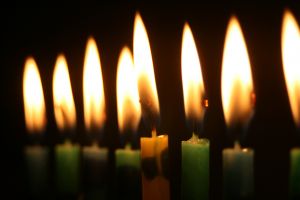
By Jewish law, Hanukkah is a minor holiday. It has gained its prominence only in proximity to Christmas. Nonetheless, its message of religious diversity, tolerance and freedom is one that has been both challenged and faithfully rekindled over millennia.
Hag Sameach!
One Response to “Come Light the Menorah”
Leave a Reply

Todah rabah, Jody, for the Hanukkah commentary. Like you and many other Jewish families, we too have created traditions down the years that add tapestry to the celebration of Hannukah. The smells of Latkes (and the inevitable mess that comes along with making them!), the sounds of our sons chanting the blessings as we light delicate candles that adorn our Hanukkiot, the cackle that accompanies our kids’ reactions to presents that they’ve “always wanted”, and the soft glow of burning candles that illuminate the room…that, in so many ways, illuminate our lives. And yet, through all of it, we are reminded that but for a small band of Jews in a place and time so far away, we might not have the privilege of celebrating our religious and cultural traditions as we do.
Chag Hanukkah Sameach to you and yours.